Natural fibre rugs have moved from a niche coastal look to a core floor-covering category for many retailers. For importers building 2027 ranges, jute is often the anchor: it is versatile across price points, works in both neutral and colour-led collections, and carries a sustainability story that end customers increasingly ask about.
This guide covers what wholesale buyers should know before placing jute rug orders with an Indian manufacturer, from demand signals to specifications and quality checks.

Why Jute Rugs Remain a Strong Wholesale Category
Two signals support continued demand.
First, retail data points towards natural materials. In its 2026 trends release, Rugs.com reported that wool, jute and other natural-fibre rugs were outperforming synthetic versions, with shoppers drawn to eco-friendly construction and durable, long-lasting pieces. The same release named washable rugs as its fastest-growing category, which is a useful reminder that many ranges now need both natural-fibre and easy-care options.
Second, Indian export data shows recovery. According to DGCIS figures compiled by the Jute Products Development and Export Promotion Council, India’s exports of jute manufactures including floor coverings rose from USD 0.34 billion in 2023–24 to USD 0.38 billion in 2024–25. The category peaked at USD 0.51 billion in 2021–22, so there is room for growth as buyers rebuild natural-fibre programmes.
Jute Rug Constructions to Specify
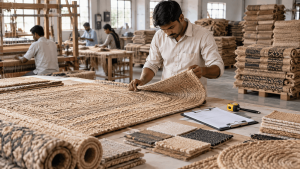
“Jute rug” covers several distinct products. Being precise in your brief avoids sample rounds that miss the mark.
Braided Jute Rugs
Jute yarn is braided and then stitched into round, oval or rectangular shapes. Braided rugs suit casual and coastal ranges and are a common entry-price option.
Flatweave and Handloom Jute Rugs
Woven on looms in plain, herringbone or textured patterns. These give a flatter, more tailored surface and are widely used for living-room and dining-room sizes.
Jute Blends
Jute combined with cotton, wool or chenille to add softness, colour or pattern. Blends help buyers offer the natural look with a softer hand, which can widen the customer base for a range.
Manufacturing methods vary by design and material, so confirm with your supplier which construction is used for each SKU. More Textiles’ jute range covers.
What to Check Before Placing a Wholesale Order
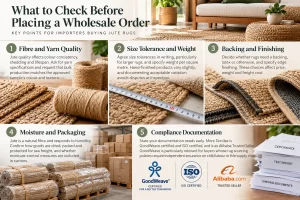
Fibre and Yarn Quality
Jute quality affects colour consistency, shedding and lifespan. Ask for yarn specifications and request that bulk production matches the approved sample’s colour and texture.
Size Tolerance and Weight
Agree size tolerances in writing, particularly for larger rugs, and specify weight per square metre. Hand-finished products vary slightly, and documenting acceptable variation avoids disputes at inspection.
Backing and Finishing
Decide whether rugs need a backing, latex or otherwise, and specify edge finishing. These choices affect price, weight and freight cost.
Moisture and Packaging
Jute is a natural fibre and responds to humidity. Confirm how goods are dried, packed and protected for sea freight, and whether moisture-control measures are included in cartons.
Compliance Documentation
State your documentation needs early. More Textiles is GoodWeave certified and ISO certified, and is an Alibaba Trusted Seller. GoodWeave is particularly relevant for buyers whose rug sourcing policies require independent assurance on child labour in the supply chain.
Pricing and MOQ: What Drives the Quote
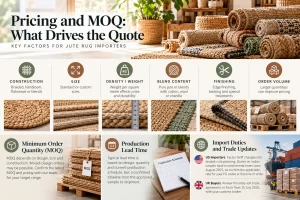
Jute rug pricing depends on construction, size, density, blend content, finishing and order volume. Rather than comparing headline prices, compare like-for-like specifications.
Minimum order quantities and pricing for More Textiles’ jute rugs are [CONFIRM WITH CLIENT: MOQ per design/size and whether mixed-design orders are accepted]. Typical production lead time is [CONFIRM WITH CLIENT: jute rug lead time from approved sample].
For US importers, factor tariff changes into landed-cost planning. Duties on Indian carpets have moved several times since August 2025, so confirm the applicable rate for your HS codes at the time of order. UK buyers should review the India–UK trade agreement, in force since 15 July 2026, with their customs broker.
Building a Jute Range That Sells Through
A balanced wholesale programme often combines:
- A core of neutral braided and flatweave styles in standard sizes
- A smaller set of blends or patterned designs for seasonal refresh
- Coordinating products, such as jute storage baskets, poufs or placemats, to increase basket size
More Textiles produces jute rugs alongside storage baskets, poufs and table linen in Panipat, which can simplify consolidation for buyers who want a coordinated natural-fibre collection.
If you are planning a jute range for 2027, share your target sizes and quantities and our team can suggest constructions and a sampling plan to match.
Sources
- Business Wire / Rugs.com, 2026 rug shopping trends release (16 July 2026): https://www.businesswire.com/news/home/20260716839403/en/
- JPDEPC, India’s 10 Years Exports of Jute Goods FY 2014-15 to 2024-25 (DGCIS data): https://jpdepc.org/wp-content/uploads/2025/06/Enclosure-II-Indias-10-Years-Exports-of-Jute-Goods-from-F.Y-2014-15-to-2024-25-1.pdf
- DD India, carpet tariff cut (4 Feb 2026): https://ddindia.co.in/2026/02/tariff-cut-to-revive-indian-carpet-exports-to-us-say-industry-experts/
- The Tribune, India-UK agreement entry into force (18 June 2026): https://www.tribuneindia.com/news/world/india-uk-trade-agreement-will-enter-into-force-from-july-15-foreign-secy-misri-calls-announcement-one-of-the-key-outcomes/
- More Textiles homepage (product categories): https://moretextiles.com
Leave a Reply