A well-made textile collection can still miss its commercial moment. Rugs arrive after a store launch, cushions land after a promotion, or throws reach the warehouse too late for the season they were designed for. The problem may begin long before shipment: an incomplete brief, a delayed sample decision or a delivery plan that stops at the factory gate.
For importers planning home textile sourcing from India, the useful starting point is the date stock must be available to sell. Work backwards through warehouse intake, customs clearance, freight, inspection, production and sampling. That approach gives retailers and wholesalers a clearer basis for planning their 2027 ranges with an Indian manufacturing partner.

This guide focuses on spring/summer programmes in the UK, USA and European markets. Australian buyers can use the same planning method but should align the dates with their own seasons and promotional calendar.
Why October to January matters for 2027 sourcing
For a collection intended to reach shelves in March or April 2027, October and November 2026 are useful months to resolve the buying brief, review samples and discuss production capacity. Waiting until January to begin every stage may leave too little time once freight and destination handling are included.
Ask the supplier for a calendar that separates development from bulk production. A first sample, a revised sample and an approved pre-production reference serve different purposes. Clarify which approvals and commercial conditions must be completed before the production lead time starts.
Request the factory’s actual holiday and closure schedule, including any planned changes around Diwali and year-end. Do not assume that every Indian manufacturer observes the same shutdown or that a seasonal enquiry guarantees an early production slot. Obtain a written schedule for the order being discussed.
Start with the warehouse date, then work backwards
“Ready to ship” and “ready to sell” are different milestones. A supplier may complete production on the agreed date while your launch still depends on freight departures, clearance, inland delivery and receiving appointments.
Build your sourcing calendar in this order:
- Set the selling date. Record the store launch, catalogue release or promotion the stock must support.
- Set the warehouse deadline. Allow for receiving checks, labelling, allocation and distribution to stores or customers.
- Confirm the transport plan. Ask your freight partner about the selected route, service, cut-off dates and destination handling.
- Agree the goods-ready date. Include final inspection, any corrective work and packing before handover.
- Confirm production requirements. Obtain the supplier’s lead time for the selected materials, quantities and construction.
- Schedule sampling and approvals. Leave room for revisions, tests and packaging sign-off before bulk production is authorised.
Add a contingency appropriate to the programme rather than assuming that every stage will run at its shortest estimate. If the schedule does not fit, discuss a smaller initial range, a phased delivery or a later launch before placing the order.
A working home-textile buying calendar for 2027
The following is an example planning framework for an early spring launch. It is not a fixed manufacturing or freight schedule; confirm every milestone with the supplier and logistics partners.
| Planning window | Buyer priorities | Decision to secure |
|---|---|---|
| October–November 2026 | Share briefs, shortlist designs, request samples and check capacity | Product direction and a feasible development schedule |
| November–December 2026 | Review revisions, specify labels and packaging, confirm testing needs | Approved specifications and an order date that supports the required arrival |
| December 2026–January 2027 | Release orders when the agreed approvals and terms are complete; monitor production milestones | Confirmed goods-ready dates and a transport plan |
| January–March 2027 | Follow the agreed production, inspection, booking and dispatch schedule | Documented shipment readiness and an achievable warehouse arrival |
| March–April 2027 | Receive and allocate stock according to the launch plan | Stock available for sale, with replenishment needs identified |
The windows overlap because different products may follow different schedules. A January purchase order is not automatically suitable for a March shelf date. Likewise, a March dispatch should not be presented as a March delivery without checking the complete route and receiving plan.

How Heimtextil 2027 fits into your sourcing plan
Messe Frankfurt confirms that Heimtextil 2027 takes place from 12 to 15 January 2027 in Frankfurt am Main. The fair covers home and contract textiles and textile design. Check the official Heimtextil information when planning your visit.
For an early spring collection, use January meetings to progress work that is already sufficiently advanced. Share product briefs and questions before the meeting, bring the latest specification, and identify the decisions you need to make. A discussion about an approved sample is more actionable than an open-ended request for a new collection.
The fair can also support later-season development and new supplier conversations. Keep those projects separate from orders with an immediate delivery deadline. Confirm each supplier’s attendance directly; a sourcing plan should not assume that More Textiles or any other company has a stand or meeting slot booked.
Trade and landed-cost checks for international buyers
UK importers: check CETA eligibility for the actual product
The UK government confirms that the India–UK Comprehensive Economic and Trade Agreement took effect on 15 July 2026. Its official trade-deal overview describes tariff reductions across a broad range of goods.
For a textile purchase, verify the commodity code, applicable preference and required origin evidence for the actual product. The agreement’s rules of origin set conditions for preferential treatment; buying from an Indian supplier alone does not establish eligibility. Use the UK Trade Tariff service and your customs broker to confirm the treatment of the shipment.
US importers: avoid using one headline tariff as a total rate
US–India trade measures have been the subject of policy changes and negotiations. The February 2026 joint statement described a reciprocal-tariff framework; it should not be treated as a guaranteed all-in duty rate for every textile entering the USA in 2027.
Ask your customs broker to check the current US Harmonized Tariff Schedule, relevant notices, classification and origin for each product. State the date and assumptions behind the landed-cost calculation, and agree how the quotation will be reviewed if applicable charges change.
For other destinations, carry out the same product-specific review using the relevant customs authority. Keep manufacturing price, freight, duties, taxes and destination handling visible as separate cost items.
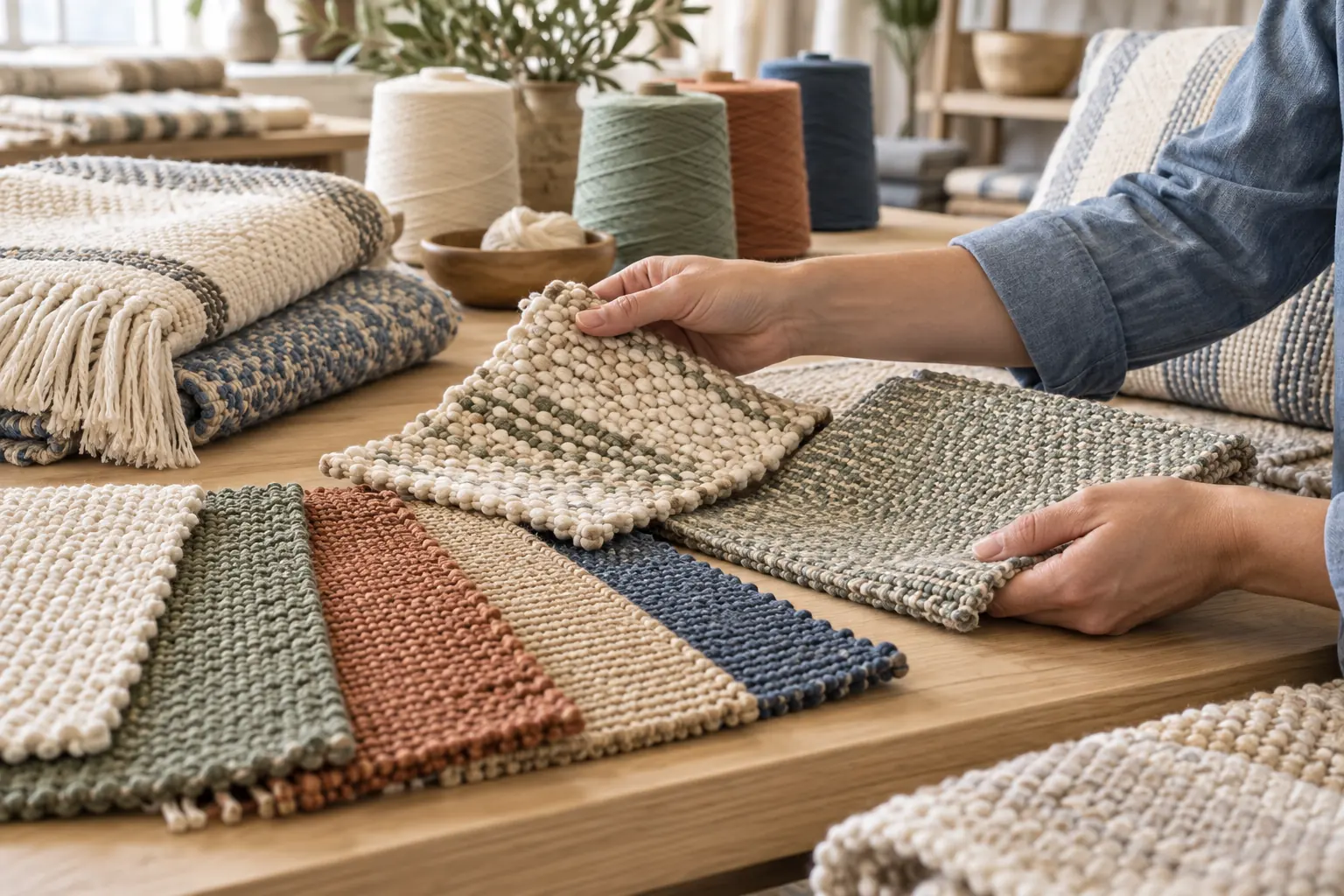
Send a supplier brief that can be acted on
A useful brief gives the supplier enough information to assess feasibility and quote the intended product. Include:
- Product and construction: rug, cushion cover, throw, bathmat or other category; specify the fibre and technique where known.
- Dimensions and finish: sizes, weight basis if relevant, edges, backing, closures and decorative details.
- Design references: colour direction, artwork, pattern placement and acceptable variation.
- Quantity by SKU: approximate or confirmed quantities for each design, size and colour.
- Commercial target: target price basis, delivery destination and required warehouse date.
- Presentation: labels, barcodes, retail packaging, carton assortment and any special packing requirements.
- Approval requirements: samples, tests, inspection arrangements and the documents your organisation needs.
Ask for MOQ, sample charges and lead time against that brief. These details can vary by construction and order mix, so they should be confirmed in the quotation rather than filled with a generic industry estimate.
For category-specific preparation, use the existing jute and cotton rug comparison and throw-blanket sourcing guide alongside your product brief.
Frequently asked questions
When should I start sourcing for spring/summer 2027?
Start as soon as you can define the required warehouse date. For an early spring launch, use autumn 2026 to resolve development and feasibility rather than relying on a January start. The exact order deadline depends on the agreed production and logistics schedule.
Should I wait until Heimtextil to place my order?
Only if the resulting timeline supports your launch. The fair can help confirm an advanced programme, but it should not replace earlier sampling and planning when delivery dates are tight.
Does production lead time include shipping?
Do not assume it does. Ask the supplier to define the start and end points of the quoted lead time, then schedule freight, clearance and warehouse intake separately.
What certifications should I request?
Specify the documents required by your buying policy and destination market. Request current evidence covering the relevant company, facility or product scope, and check it during approval rather than relying on a logo alone.
Plan your next home-textile collection with More Textiles
More Textiles supplies rugs and home furnishings from Panipat, India. Explore its cushion covers, bathmats, hand-tufted woolen rugs and poufs and ottomans to identify the categories you want to discuss.
Send More Textiles your sourcing brief, including product references, quantities, destination and required warehouse date. Ask the team to confirm available options, sample terms, category-specific MOQ and a proposed production schedule. Working back from the date you need the stock gives the conversation a clear commercial purpose and helps keep your 2027 buying plan realistic.
Leave a Reply