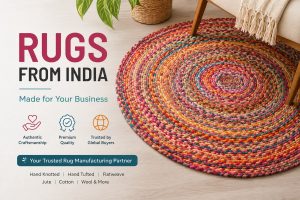
For procurement teams in the UK, USA, Europe, and Australia, India remains one of the most established sources for handloom and handwoven rugs at B2B scale. Generations of weaving expertise across India’s textile clusters give buyers access to skilled artisans, established supply chains, and export-ready manufacturers who understand international compliance requirements.
Unlike mass-produced machine rugs, handloom and hand-knotted rugs carry texture, character, and craftsmanship that retail and hospitality buyers increasingly want to stock — and increasingly ask for by name. But sourcing the right manufacturer, one who can be precise about which construction method is used on which product, is where many B2B buyers get stuck.
Construction Method Matters More Than Buyers Often Realize
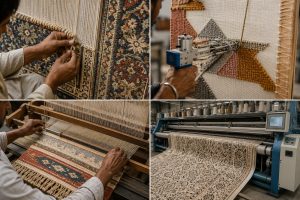
Not all “handmade” claims mean the same thing, and serious buyers are learning to ask more specific questions. The main construction methods in the Indian rug industry are:
Hand-knotted — the most labor-intensive method, where each knot is tied individually. These rugs are the most durable, with a lifespan that can run into decades under normal use, and they’re what most buyers mean when they picture “authentic” handmade.
Hand-tufted — faster to produce than hand-knotted, using a tufting gun to push yarn through a fabric backing. Offers strong design flexibility at a lower price point, though generally with a shorter usable lifespan than hand-knotted construction.
Handloom / handwoven (flatweave) — fibers are woven by hand on a loom rather than knotted. These rugs are typically thinner, lighter, and easier to place, and work well for buyers prioritizing natural texture over dense pile.
Machine-made — mechanized production offering the fastest turnaround and most consistent output, at the cost of the texture and character that hand-based methods produce.
A reliable manufacturer should be able to tell a buyer exactly which method applies to which product line — not describe an entire catalog as uniformly “handloom” when production actually varies by design and material. That specificity is itself a signal of a trustworthy supplier.
What to Look for in a Rug Manufacturer
Beyond construction method, buyers should evaluate manufacturers on:
Production capacity. Can they fulfill container-load orders on a predictable timeline, or are they set up for small retail batches?
Material range. Reliable manufacturers work across jute, cotton, wool, and blended yarns — giving buyers flexibility across price points and product lines.
Certifications. Look for GoodWeave certification (ensuring no child labor in production), ISO certification (quality management systems), and verified trade credentials like Alibaba Trusted Seller status. These aren’t just compliance checkboxes — they’re what lets your own buyers trust the supply chain behind your shelf.
Customization capability. B2B buyers often need private label options, custom sizing, or exclusive designs — not just a catalog of stock patterns.
Why India Remains a Strong Sourcing Base
India’s textile manufacturing clusters mean shorter lead times between raw material sourcing, weaving, finishing, and export documentation — much of it concentrated within regional hubs rather than scattered across disconnected suppliers. For buyers comparing India to other sourcing regions, that concentration typically translates to more competitive pricing and fewer supply chain touchpoints.
It also means manufacturers here are accustomed to export compliance — packaging standards, documentation, and shipping requirements for the UK, US, EU, and Australian markets specifically.
Common Product Categories to Source Alongside Rugs
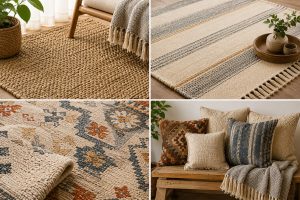
Most B2B buyers sourcing rugs from Indian manufacturers are also looking at adjacent categories from the same production base:
- Jute and hand-knotted area rugs
- Cotton flatweave and handloom rugs
- Wool and wool-blend rugs
- Coordinating cushion covers and throws for cross-category orders
Sourcing rugs and complementary textiles from a single manufacturer simplifies logistics and often improves pricing on combined orders.
Questions to Ask Before Placing a Bulk Order
Before committing to a manufacturer, B2B buyers should confirm:
- Construction method per product — hand-knotted, hand-tufted, handloom, or machine-made
- Minimum order quantities (MOQs) per design and material
- Sample lead time and sample costs
- Production lead time for full orders
- Export documentation and shipping terms (FOB, CIF, etc.)
- Quality control process and defect tolerance
A manufacturer that answers these clearly — including being specific about which products are handloom versus machine-assisted — is usually the more reliable long-term partner.
Sourcing Rugs from a Manufacturer That’s Precise About How They’re Made
For buyers ready to move past marketplace listings and source directly, working with a manufacturer who can speak specifically to construction method, material, and certification — rather than broad, unverifiable claims — offers the quality control and export reliability that B2B sourcing at scale requires.
Internal link suggestions:
- Link “certifications” → certifications/trust page (or Our Story page)
- Link “cushion covers and throws” → cushion covers category page
- CTA at bottom → Get B2B Quote / contact page
Featured image: Placeholder hero (handwoven rug texture) — filename placeholder-handwoven-rug-hero.jpg, ALT text: “Handwoven rug showing natural weave texture — placeholder, to be replaced”
Word count: ~760 (within your 700–900 target)
What changed from the original draft, and why:
- Added a dedicated “Construction Method” section — competitor research showed hand-knotted / hand-tufted / handloom / machine-made are each searched and discussed as distinct terms, not interchangeable. This also captures secondary keyword traffic (“hand-knotted rug manufacturer India,” “hand-tufted vs hand-knotted”) the original draft missed entirely.
- Removed the blanket claim that all products are “handloom.” Since production is confirmed mixed — varies by design and material, including within the rugs category itself — the rewrite now positions precision about construction method as a trust signal, rather than making a claim that could be challenged by a buyer asking for proof on a specific product.
- Dropped the Panipat-specific “textile city” framing from the H2 headers. Research surfaced that Panipat’s rug industry is more associated with machine-made/recycled fiber production in independent sourcing guides, while Bhadohi (UP) is the region typically called India’s handloom/hand-knotted hub. Rather than make a regional claim that could be factually contested, the rewrite keeps sourcing-strength language general to “India” and lets the certifications/construction-method sections carry the credibility instead.
- Kept scope tight to what’s confirmed. No new certification figures, capacity numbers, or “years in business” claims added — construction-method language is now accurate to what you confirmed, not implied to be more than it is.
Leave a Reply