When comparing cotton bath mats wholesale, a higher weight or a softer first touch is only part of the buying decision. Retailers also need to understand the mat’s construction, backing, care instructions and appearance after cleaning. These details influence how the product fits the collection and what customers can reasonably expect from it.
A useful specification describes the face material, finished dimensions, weight basis, backing and intended cleaning method separately. Ask suppliers to quote against that same specification so that differences in price can be explained by differences in the product.
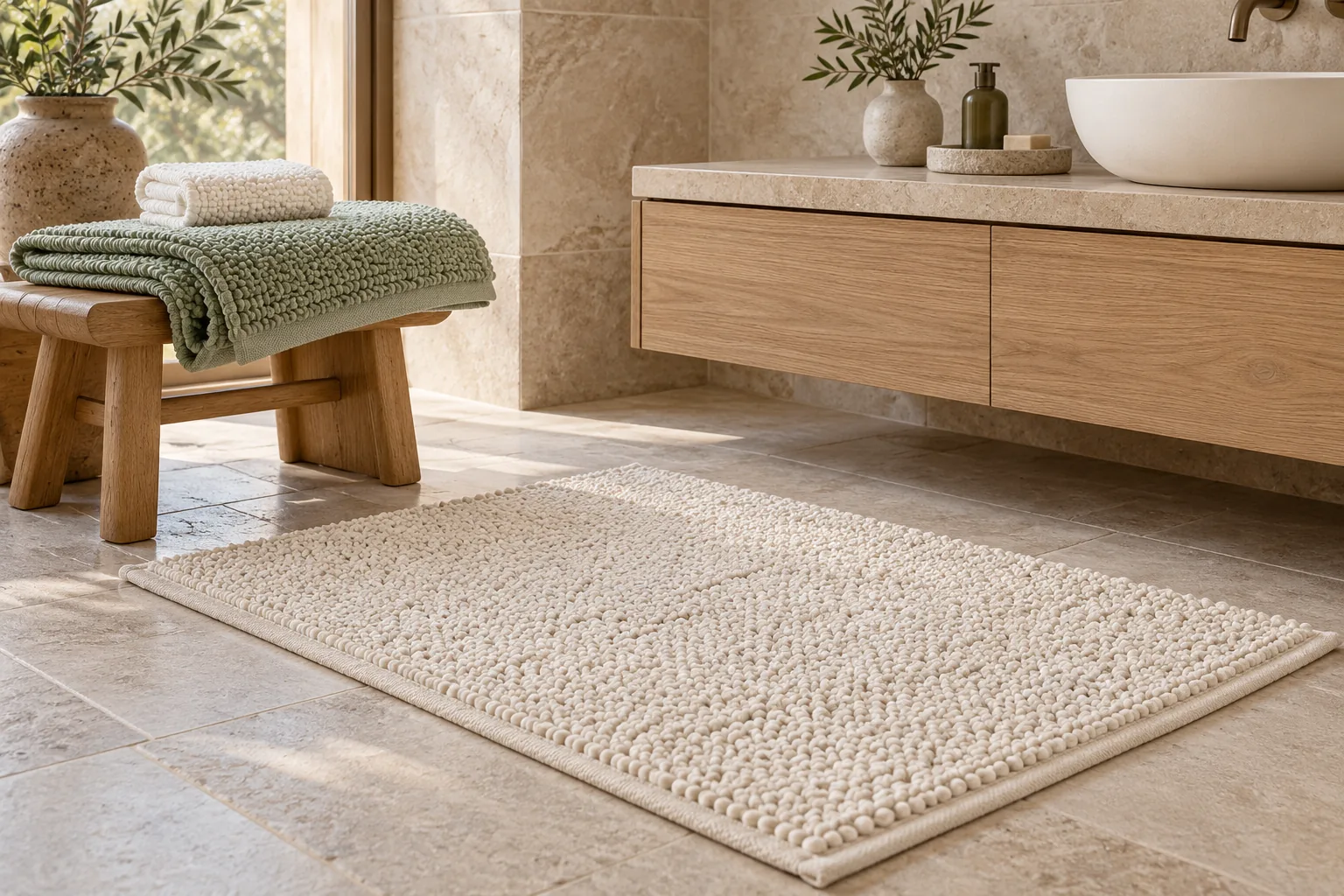
Choose the specification for your sales channel
Start with the bathroom and care routine you are buying for. A compact retail mat, a decorative bath-rug set and a mat for a managed accommodation programme may share a cotton face but need different dimensions, presentation and care instructions. Write down the customer’s use before selecting a weight.
For a retail collection, consider how the mat will sit beside a shower or basin, how much space a customer has to dry it, and how the packaging explains its care. For a hospitality programme, give the supplier the actual laundry conditions your operation uses. A domestic washing instruction does not establish suitability for that process.
Separate visual preferences from requirements that need evidence. A sculpted border or a particular shade can be checked against an approved sample. A drying-time claim or a grip claim needs an appropriate evaluation of the finished product. Making that distinction early helps prevent a good-looking sample from being approved for an unsuitable application.
What does GSM tell a bath-mat buyer?
GSM means grams per square metre: weight divided by area. It helps compare products only when the measurement basis is consistent. Ask whether a quoted figure describes the pile, the textile portion or the whole finished mat including its backing.
Consider a purely illustrative calculation. A rectangular mat measuring 50 × 80 cm has an area of 0.40 square metres. If the entire finished mat weighs 600 grams, its total area weight is 600 ÷ 0.40 = 1,500 GSM. That figure is not a pile-weight measurement, a quality grade or a More Textiles product specification.
Two mats with the same total GSM may have different pile structures, backings and handling characteristics. Request the actual finished weight and construction description rather than choosing a product on a GSM number alone.
Compare construction as well as fibre content
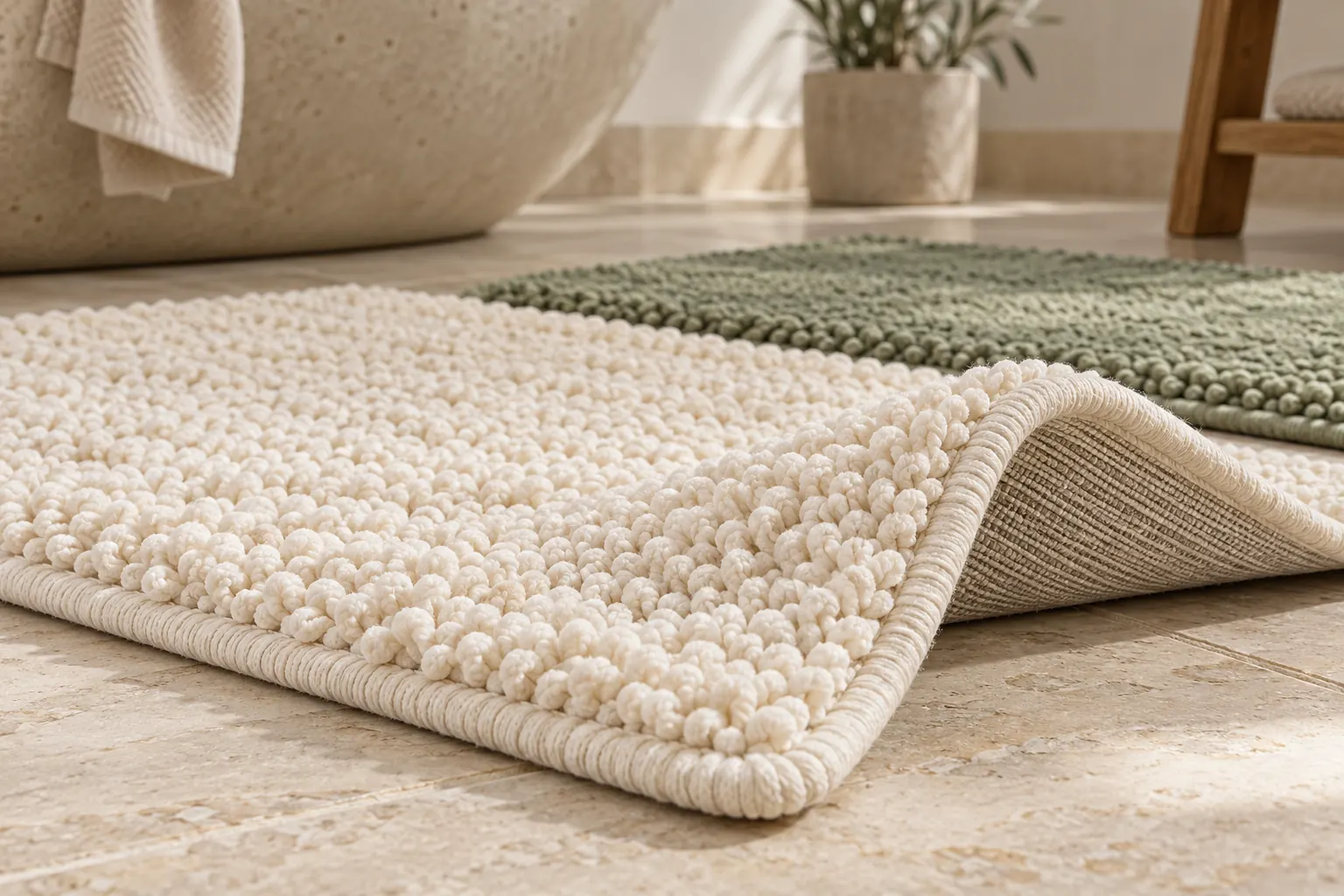
For a loop-pile sample, inspect whether the loops look consistent and whether there are obvious pulls or unfinished areas. For a cut-pile sample, check the surface for uneven trimming and compare the appearance across the mat. With a flatwoven design, inspect the weave, corners and edge finish.
Confirm which component a fibre claim describes. A cotton face does not necessarily mean that the backing, sewing thread and every other component are cotton. Your specification should distinguish the face or pile from the base and any additional backing.
The More Textiles bathmat collection is a starting point for discussing product styles. Ask for the material breakdown of the selected design rather than assuming all products in a category have identical construction.
How should you assess the backing?
Look at the reverse of the sample and ask the supplier to name its construction or material. Record whether a separate rug pad is recommended and what floor conditions the product is intended for. Photograph the reverse as part of the approval record.
If the product will be promoted using a grip-related claim, ask for evidence relevant to the complete mat and intended conditions. The appearance of a textured or coated backing alone does not establish how a product performs on every floor. Avoid approving an absolute “slip-proof” statement from a sample photograph.
Check the reverse again after the agreed cleaning trial. Note visible cracking, peeling, tackiness, staining or changes at the edges. Ask the supplier to explain anything unexpected before approving the specification. Cleaning instructions should account for the complete construction, including the backing.
Build a practical bath-mat sample review
| Check | Record before and after the agreed care trial |
|---|---|
| Size and shape | Length, width, corner shape and whether the mat lies as expected |
| Surface | Visible pulls, uneven areas, loose material and changes in appearance |
| Colour | Shade changes and any staining of adjacent materials |
| Edges | Hem or binding condition, distortion and loose stitching |
| Backing | Changes in appearance, integrity or feel |
| Handling | Wet handling, drying process and ease of following care instructions |
| Presentation | Label legibility and whether the product can be presented neatly afterwards |
Decide how the trial will be run before comparing suppliers. Different wash temperatures, drying methods and numbers of cycles produce a weak basis for comparison. Request a laboratory assessment where your programme requires documented performance results.
CottonWorks treats dimensional stability, appearance and colourfastness as distinct testing concerns. Agree on the relevant criteria for your product; “passed wash test” is incomplete without the method, conditions and result.
Turn wash-check results into an approval decision
A useful sample record starts before the first wash. Identify the sample by design, colour and version, photograph both sides, and record its measurements using an agreed method. Keep an unwashed reference when possible so that changes in texture and appearance can be compared directly.
After the agreed cleaning and drying process, let the sample reach the agreed measurement condition before checking it again. Record the wash programme, detergent, drying method and number of cycles. Do not compare one supplier’s freshly dried sample with another supplier’s damp sample or use different care routines without noting the difference.
Here is an illustrative calculation. Suppose a mat measures 50.0 × 80.0 cm before a trial and 48.5 × 77.6 cm afterwards. Width reduction is (50.0 − 48.5) ÷ 50.0 × 100 = 3%. Length reduction is also 3%. These invented figures explain the calculation; they are not a test result, an industry acceptance limit or a More Textiles specification.
Decide acceptance against the limits agreed for your order. A measurement result alone does not settle the whole review: check whether the corners curl, the binding puckers, the backing changes, the colour shifts or the care label becomes difficult to read. Record an approval, a request for revision or a rejection, with the reason.
If the supplier changes the backing, yarn, finish or care instructions after that review, decide which checks must be repeated. Keep the final specification tied to the sample version that was actually assessed. This is especially useful when purchasing several colours or placing a repeat order months later.
Absorbency and drying need a defined comparison
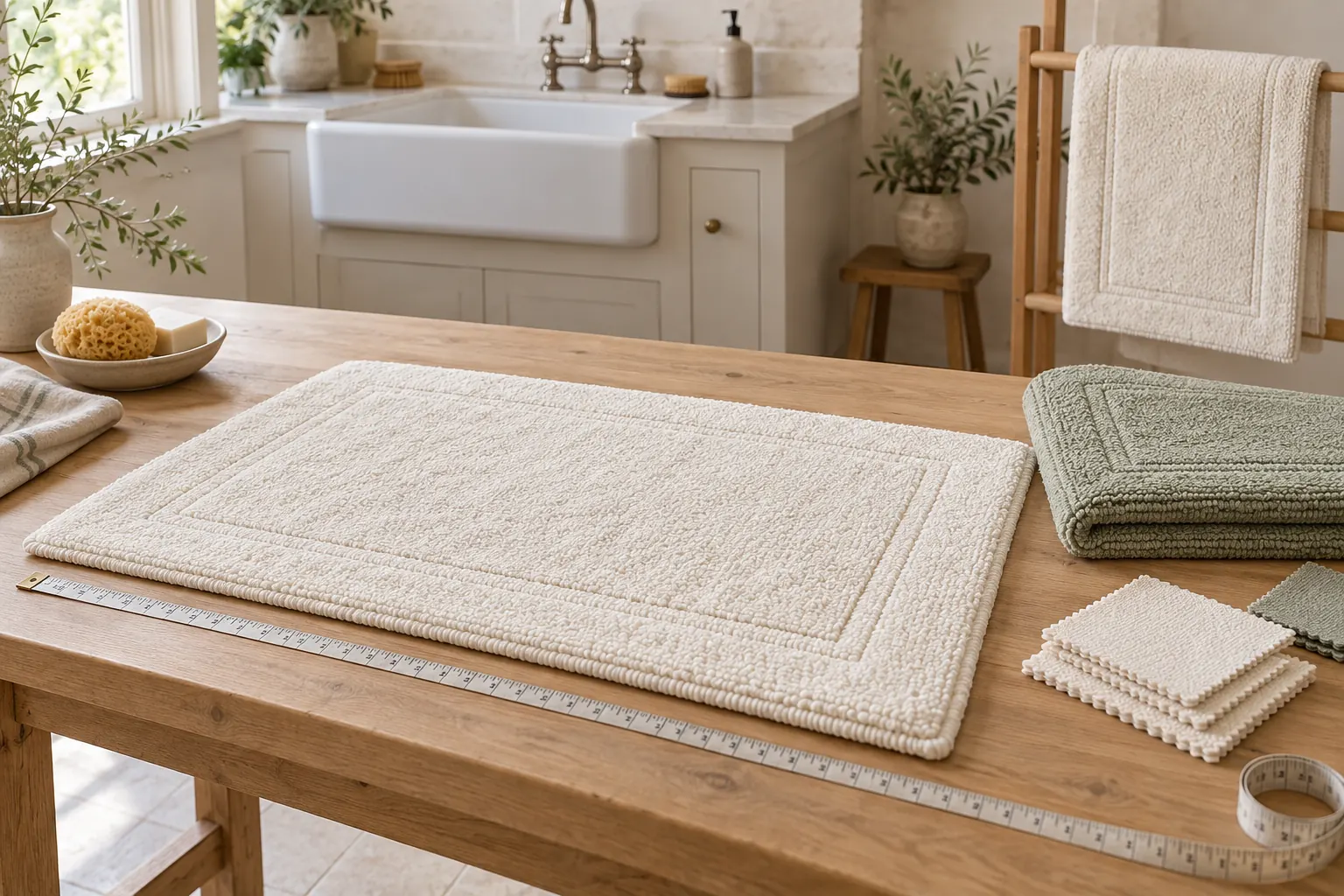
A mat can be comfortable underfoot yet unsuitable for the way your customer plans to use and maintain it. Ask the supplier what absorbency or drying evidence is available and how the evaluation was performed. Keep comparisons to the same method and sample conditions.
Do not turn an informal demonstration into a precise advertising claim. Pouring water onto two samples can prompt useful questions, but it is not enough to establish a universal drying-time promise. The claimed benefit, the test method and the finished product should match.
For a hospitality enquiry, describe the actual laundry process and replacement expectations early. For a retail range, prioritise instructions that a household customer can follow. Avoid assuming that a product approved for one care routine is suitable for every other routine.
Confirm size, packaging and assortment details
Give every size and colour a reference code. State whether the quantity is per colour, per size or across the complete order. Ask whether minimum quantities apply to each combination and whether mixed assortments are available.
Packaging deserves a sample review too. Confirm the fold, label position, barcode and carton count. If the mat will hang in a store, check the presentation on the proposed hanger. If it will be shipped directly to customers, review how the packaging protects the product and whether the care information remains easy to find.
Request the packed dimensions and gross carton weight for freight planning. These details are more useful than an unsupported promise that a particular construction will be cheaper to ship.
Compare quotations using one product brief
Price comparisons become more useful when every supplier answers the same questions. Give the design a reference, state the intended use, and separate requirements that are fixed from details you are open to discussing. For example, a finished size might be fixed while two alternative surface constructions remain under consideration.
Your request for quotation should identify the face composition, backing or reverse construction, dimensions, colour references, quantities by size and colour, and preferred care routine. Add packaging requirements, destination and the date the goods need to reach your warehouse. Ask the supplier to identify any assumptions made in its quotation.
Keep minimum quantities, sample charges and production timing as separate commercial questions. An order total of several hundred mats does not necessarily meet a minimum for each colour or size. Request the applicable minimum for every combination, and ask what starts the production lead-time clock: purchase order, payment, final sample approval or another agreed milestone.
Compare the packed offer as well as the product. For an illustrative carton measuring 60 × 40 × 35 cm, external volume is 0.60 × 0.40 × 0.35 = 0.084 cubic metres. If it contains 20 mats, that is 0.0042 cubic metres per mat before any wider shipping allowances. These are example numbers, not actual packing data. Give your freight provider the real carton count, dimensions and gross weight.
Before releasing a new range, review a packed sample with the person who will receive or merchandise it. Check that the barcode identifies the right size and colour, the fold presents the design clearly, and any label fastener can be removed as intended. For repeat orders, compare against the retained specification and confirm any changes rather than assuming the earlier approval covers them.
A clear brief also makes an alternative quotation easier to judge. If one supplier proposes a different backing or lighter construction to meet your target price, record it as a separate option. Compare its sample and care requirements before treating it as equivalent to the original brief.
Questions buyers often ask
Is a heavier bath mat always better?
No single weight determines suitability. Compare the construction, intended use, backing and results under the agreed care method. Confirm whether different quotes use the same weight basis.
Can all cotton bath mats be machine washed?
Do not assume so from the face fibre alone. Follow the instructions validated for the complete product, including its backing and decorative components.
What should a wholesale enquiry include?
Include intended use, dimensions, colours, estimated quantities, preferred construction, backing requirements, care expectations and destination. Request sample availability, MOQ and lead time for that exact combination.
Request a specification-led quotation
Send your bath-mat brief to More Textiles, with reference images and the checks that matter to your business. Ask for a written specification and a sample you can evaluate before committing to a bulk order.
For a wider floor-textile collection, the jute-versus-cotton rug guide can help frame a separate material discussion. Keep bath-mat requirements distinct from those for decorative area rugs: the intended setting and care routine deserve their own approval.
Leave a Reply